Tuesday, May 13, 2008

How big? How close?

Back to Darrington - this is one of my favourite photoshopped pictures ever of a windfarm:

Maybe I like it because of happy childhood memories of The Tripods, but I can't help feeling that this is a little misleading - they've sited the 125m turbines right behind Pontefract town hall, which does give the most impressive looming effect, but that's way closer to buildings than the actual siting will be.

What would be fairer would be to do the same photo using the same scaling, but with a cooling tower from the nearby Ferrybridge power station, which come in at a whopping 198m, 25% bigger than the 158m high Blackpool Tower (which seems to be standard unit of comparison for these things).

So why is a smaller, less polluting wind-farm more offensive than a much bigger, more polluting coal-fired station just a few miles away?

Perhaps it's an attempt to repeat this famous picture of Black Law of Scotland:


Again, quite arresting, but I'd like to see that from a slightly different view before I make my mind up ...

Monday, May 12, 2008

Bang go the batteries ...

or perhaps "fizzzz". Whatever, there's not much going on at the moment. We went camping at the weekend, planning to go the ever-excellent Come Together festival in Henley. Getting the beer cold, I noticed the voltage on the battery dropping scarily low, to below 11volts.

This is bad.

We then found out the festival was cancelled 2 weeks ago - this is pretty bad, not least for the organisers who I've bumped into a few times here and there, and seem really decent people. It's also pretty bad for the young people of Henley and surrounding areas - I don't think the "official" Henley festival later in the year is going to make up for it, what with £60 a day, formal dress and the Gypsy Kings on a floating stage. Yet another victim of the new licensing & security laws that are driving so many worthwhile small events out ... but I digress.


Before leaving the van for the night (it was a lovely weather, and there's lots of worse places to be than Henley on a nice May evening), I did possibly the worse thing imaginable, looking back. My van came with a dual battery wiring system, so I put another battery onto the other connection. I thought it might help a bit. Looking back, this is just the first of the evening's events I'm blaming the vodka-redbull on

I'm no expert on batteries, but one thing I've learnt is that you have to be careful about matching them up in power ratings. If you connect differently rated batteries together, then the "weaker" one will drag down the more powerful one down.

The other thing to check, if you haven't been drinking all day, is if the second battery you're adding actually has any charge in it. It really does seem that if you connect a knackered flat 70 amp hour car battery to your pained 110 amp hour deep cycle battery, well ... things may not turn out well

There was blazing sunshine all day Sunday, and I turned the panels up at an angle to get the maximum power, but the input power never got much up above 2 amps, when I would have expected at least 3 amps from the conditions. Looking back, this was probably due to increased resistance from a dying battery, but I'm not sure.

During charging, the voltage struggled up to about 12.5 volts, but whenever I took the charge off to see how it was doing without, it dropped to about 10.5. This is very bad. Campsites can be a suprisingly socially hostile environment, especially when you've got a roof full of renewables and a flat battery

Luckily, my brother-in-law came to the rescue. Not only does he come with a supply of vodka and entire crates of Stella, he also had jump-leads. We tried a jump-start, and even with him revving his engine, all we managed to do was melt his leads! Even luckier, he also had a terrifying pair of industrial strength leads which finally got us going.

We limped back home, and the whilst the battery voltage was about 12.5 volts when we switched the engine off, it was down to about 10.3 after a few hours rest. The Elecsol Manual calls 10.7 v the bare minimum for their batteries.

We've had the battery for about 5 years now, the guarantee period, and it has had a hard life, so I'm not really complaining. Lessons to learn:

  • keep an eye on your voltage levels, and switch off the load when you hit 11v (at the bare minimum, though you will find it will rise when the load is taken off)
  • match your battery capacities if you link 2 or more up together
  • avoid "maintenance" after a day of drinking vodka in the hot sun on an empty stomach

and this is without mentioning the wind turbine mounting and siting fiasco ...

Thursday, May 8, 2008

Beware the cheap eBay solar panels ...

last year I got what I thought was a good deal on eBay for a 17watt solar panel


less than 10 months later, and really only a few weeks of serious operation, and it's dead! No current at all, a mere 6volts on the multimeter (you expect to see about 16v)

so beware cheapo bargains ...

Update 13/5/08 - the eBay vendor has been in touch, and offered some possible solutions ...

Tuesday, May 6, 2008

When wind turbines go bad

A whole blog dedicated to malfunctioning wind turbines ...

http://whenwindturbinesgobad.blogspot.com

but out of context --- it'll be interesting to compare the actual audited dangers from wind-turbines, as opposed to coal (hugely lethal on a hardly noticed scale) or nuclear (usually extremely safe, apart from the odd continent-poisoning catastrophe). From what I've seen, the biggest danger associated with wind-turbines is the sudden "thump" when you fall off

Thursday, May 1, 2008

Darrington Wind Farm

The village in Yorkshire I grew up in, Darrington, is being split over a proposed new wind-farm development. Well, "split" is probably the wrong word, "uninamously enraged" is probably more appropriate, at least to the people I've spoken to.

It doesn't seem that the Bankable Models Which Enable Local Community Wind Farm Ownership guidelines are being followed particularly closely, and that a landowner has done a deal with a developer, with the locals feeling as if they're having a huge development dumped on their doorstep, to provide benefit for others, with little to them.

A local campaign group has been set up - the Pontefract Windfarm Action Group, who have been active in raising awareness of the potential impact the turbines could have. One of the earlier actions was to raise a blimp to the approximate height and location of the highest point of the turbine tip:


I'll keep tracking the progress of both the wind farm and the local campaign, but it was worth looking at a map of the local area:


by the side of the wind-farm, between the nearest houses, is the A1 dual carriageway, and just to the north is Ferrybridge, the coal-fired power station that marks the beginning of "Megawatt Valley", target of the first Climate Camp.

So the proposed turbines are undoubtedly quite big, but will they have the impact on the local environment as claimed by the local action group?

Tuesday, April 29, 2008

Mo' power!

Mo' Power! the war-cry of the micro-generator - however much power you've got coming in, you always want more.

Previously, I looked at the most very basic, budget system - 5w, straight onto the battery. This produces at most half an amp, which will make sure that your battery has more of a chance of starting if you've been parked up for a while, but nothing more.

If you're going to spend any length of time in your van, going to be using the lights, pump, radio or charging your phone, then you want something with a little more oomph. Unfortunately, it's going to cost a little bit more, and be a bit more awkward to set up, but nothing impossible, depending on what you want to do and how much you want to spend.

There's 3 basic components you'll be needing now:
  • big solar panel
  • charge controller
  • leisure/deep cycle battery

Solar Panel
How big a solar panel you choose is up to you. You need ask 3 questions:
  • how much power do I actually need
  • how much space have I got
  • how much money have I got
Remembering the "current = watts divided by volts" rule, on a 12v system you're going to be something like:

Watts Amps
12 1.0
16 1.3
32 2.7
64 5.3

but do remember, this is the manufacturer's rating of the panel, not what you're actually going to see. For my van, I started with a 32 watt Unisolar FLX-32

as the manufacturer intended, or how it looks actually lashed to the top of the van:
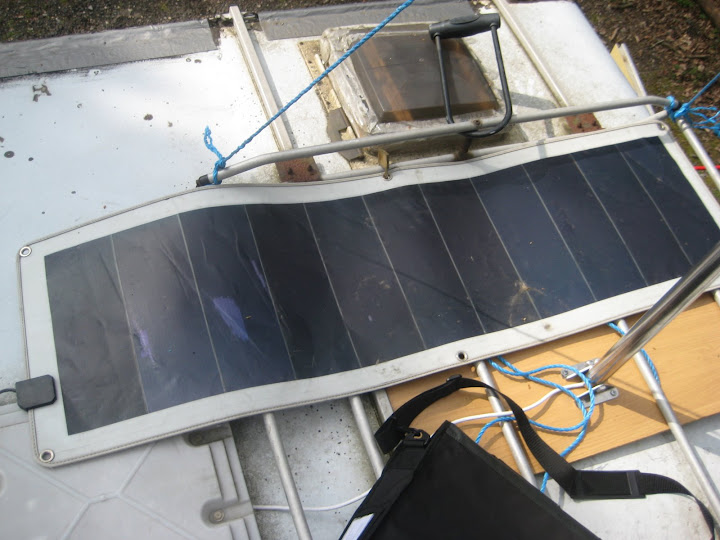
These panels are great. They're flexible - designed for yachts, being lashed to booms, sat on by hairy old sea-dogs, everything that the cruel sea can throw at them. Ideal too then for the naturally keen but clumsy. Here's the data-sheet for this series of panels


Model
Rated Power

(Watts)
Rated Voltage

(Vmp)
Rated Current

(Imp)

Open Circuit

Voltage (Voc)


Short Circuit

Current (Isc)
Dimensions

(inches)
USF-5 516.50.3023.80.3721.80” x 9.71”
USF-11 10.316.50.6223.80.7821.80”x 16.70”
USF-32 3216.51.9423.82.4056.27” x16.70”


I've highlighted the USF-32 output- 1.94 amps! More than enough to charge the phone. Unbreakable, manageable size, decent output - just one snag. Unisolar don't make them anymore ...

But there are plenty of other options, but bear in mind the size of the panel and how you're going to fix it to the roof. The guys at Solar Energy Alliance are a great place to start, but other outlets are available ... there's a lot more to say about panels, but I personally feel that 32w is the minimum you need for a van.


Charge Controller
These little rascals sit between the panel and the battery. They stop the battery being overcharged (you should be so lucky) and also stop the electricity flowing back out of the panel at night. The one I've used for years is the ICP 7 amp controller - as the manufacturer intended:
As you can see, it has 2 wires going in and out - red for positive, black for negative. The input from the panel has bare-wire, the output to the battery are rings to attach to the terminals. It's down to you to work out the best way of connecting everything together, I'll cover the way I've done it later.

If you've got power coming in from your panel, then the yellow light on the left lights up, in the eventuality you actually manage to fully charge your battery, the green on one the left comes on (it will also do this if connected to an active panel, but not a battery - check your connections).

Again, other controllers are available, but I've used this for years, it's nice and tidy, doesn't get in the way, and is reasonable value.

You'll need a charge controller if your panels are anything above 5w, but check the capacity of the controller, remembering the watts/volts rule. The 32w unisolar panel can produce about 2 amps, so the 7amp total for this controller is fine. My current full solar array can get up to about 5/6amps on a good day, and I have noticed the charge controller kicking in to slow things down. I haven't quite got to the bottom of that yet, but be careful to match your controller input to the total power of the solar panels.

Battery
The workhorse of your system. When the sun goes down, who's there for you? Not your solar panel, that's for sure. If it wasn't for the charge controller, the turncoat would be letting all your hard generated power leak out into the night.

Your battery is the foundation of your renewable energy system. Sun (and wind) are too variable to rely on at any particularly moment, and solar just isn't there when you need it at night, when you're rummaging around in the van trying to find the brandy (for example).

The type of battery you need is a leisure/deep cycle battery. These look like normal car batteries, are rated just the same at 12volts, but are specially designed to withstand repeated charge and more importantly, discharge. If you run a normal car battery flat more than a few times, then you'll kill it, and running down a battery flat can happen quite a lot.

I've used a 110 amp hour Elecsol battery successfully for several years now:

They come in all shapes and sizes, but expect to pay about £100. There's lots of rules and things to remember, but all you need to know for now is don't buy second-hand. You don't know where it's been, or what it's been through. Get yourself a nice leisure battery if you haven't got one in the van already - put it where the existing one is, it works just the same, plug in your panel and charge controller/diode and that's it!

I ran a 32watt solar panel, 7amp charge controller and 110 amp/hour battery for years - it sometimes went flat if things got left on for too long, but if the panel was left to charge the battery for a few hours without anything on the battery, it always charged enough to start the engine and get us off site

Friday, April 25, 2008

Basic campervan solar

Here's the very, very minimum you can put on your van. This is if you just want to keep your battery topped up over the winter- this is what's referred to as "trickle charging". As it sounds, you're just going to get a little bit of power literally trickling in. Depending on how big your batteries are, then you might be able to charge the phone for a bit, have the internal lights on for a bit, or even listen to the radio, again for a bit - but don't rely on it. All the power from the panel is going to go to the battery - by it's very nature, solar power is intermittent, it comes and goes during the day, then goes totally at night. So put the power into the battery, then take it out from there to ensure a constant supply.

Maplin are widening their range of solar products, starting from little personal pocket chargers to some fairly large ones - they're not necessarily the most efficient products, and you might be able to get better deals elsewhere if you know where to look, but Maplin are everywhere, and often run promotions. Check out their Alternative Energy section. You can also find all kinds of stuff on eBay.

What you get depends on how much you're prepared to spend, you get what you pay for.

All solar panels are "rated" (eg classified) in Watts. A watt is a measure of power. Technically, it's the ability to generate 1 joule per second. A joule? Pleasingly, a joule is the energy required to throw an apple up 1 metre in the air. So the Watt rating is how much power you can theoretically obtain from the panel. It's probably not going to be able to throw an apple very high though.

The battery you're going to be plugging into is going to be 12 volts. The current going in and out is measured in amps - the rule is that current equals watts divided by volts. So, in a 12v system, to find out what the current going in is going to be, divide the rated power in watts by12. As a reference point, mobile phones seem to draw about 0.5 amps when charging.

Maplin and eBay panels at the moment (April 2008) seem to start at 1.5 or 2.4 watts, both for about £15, then about 5w for £30-40. But bear in mind that this is theoritical maximum, and it's pretty unlikely you're ever going to see that. So our budget panels will give us ...

Watts Amps
1.5 0.13
2.4 0.20
5 0.42

feel the power! Even if you have a 5 watt panel in maximum conditions at midday with the angle right and everything, you're not going to be able to directly charge a mobile phone. But you will stop your battery going flat.


Installation of these panels is incredbily easy - just stick the panel on the roof, and run the cable down to the battery. Depending on what you've bought, you often get 2 big crocodile, like in jump leads. Attach each lead to the correct battery terminal (red for positive, black for negative), and that's it - you've got power! One thing to note - you've created an electrical circuit, with power being collected during the day from the solar panel, and sent down to the battery. Unfortunately, this is a 2 way process - at night, the power is going to flow back the other way. Unless you want the panel to heat the night sky, either make sure you unplug it at night (hassle, and you'll forget), or get a panel with a blocking diode (it'll say on the box).


Above 5w, you're going to need extra bits, but that's all you need to get started!